Environmental Lesson Plan--Week Two
- Sarah Hopkins
- Apr 7, 2020
- 11 min read
Updated: May 4, 2020
Day 1: Finishing overfishing and addressing the importance of litter
Science
Today in science will explore the issues of litter.
Begin with questions, "What is littering?" "Why is it bad?" "How much litter do you think there is?" "Is there litter in the ocean?" "Where does it come from?" etc. Don't answer the questions, but let the students answer and praise right answers and be kind to wrong ones.
Have the students fll out a KWL chart (Know, Want to know, Learned) about the topic before doing anything further. Have them write out their questions, what they know, and what they want to know. At the end, they'll write in what they learned and turn the sheet in.
Show the students this video on litter awareness that describes what litter is. https://www.youtube.com/watch?v=xFPoIU5iiYQ
Ask students what they noticed about the video and discuss it.
Ask students what they think the most dangerous kind of litter it. Answer is plastic.
Show this video on the negative effects of plastic waste on the environment and on humans:
Next play this clip from National Geographic showing how much plastic is in the ocean: https://video.nationalgeographic.com/video/news/0000015d-5b4a-d466-a57f-dbca7e850000
Ask the students what questions they have ans answer as many as you can in 5-10 minutes. Then have the students finish filling out their KWL charts. If you want, at the end, ask them to write down any more questions they have about the subject and write out answers or resources to hand back to them the next day.
If there is time, the teacher can optionally share a clip from this video as well that shows the impact of litter on Florida's aquifers--a real sight to behold. For context, two divers are mapping the aquifers while researchers follow them above ground. Begin the video at 2:40 and end at 5:21.
Video Link: https://www.youtube.com/watch?v=a3SwCnFCumU
Math
Play the game about overfishing found here for about 20 minutes: https://www.calacademy.org/educators/lesson-plans/sustainable-fishing
Go back to finding the sum and differences of angles for review. Do a game of jeopardy with word problems, basic problems, questions with diagrams, etc. depending on the level of difficulty. Categories should cover area and perimeter of rectangles, sums of angles, differences of angles, find the missing angle (i.e. the total angle is 45, one angle is 30, what is the missing one?), and measure this angle (which would have either projected images or something like "measure the angle on Card A" and then the teacher would give the group Card A"). Word problems can and should absolutely be included relating to littering, overfishing, and this week's big topic: invasive species.
For example, "Burmese Pythons are found in Zone A on this map (Zone A would be a rectangle). How much land on this map has the Burmese Python infiltrated?"
Day 2: Field trip to Apollo Beach
Today the students will go on a field trip to Apollo Beach to see the manatees at the manatee viewing center by Big Bend Power Station. Address: 6990 Dickman Rd, Apollo Beach, FL 33572.
This is best done in the winter when more manatees (hundreds) flock here for warmth.
Students will be in groups of five or six, one chaperone for each group. They will have a chance to view the manatees, learn more about them, pet sting rays, have lunch, and observe some beautiful scenery off the dock of the viewing center.
We will leave at 8:00 for our 45-60 minute bus ride there, and head back around noon for our 45-60 minute bus ride back. We will be back no later than 1:20 with plenty of time before school lets out at 1:55.
Time left in class after returning from the field trip will be spent discussing the manatees and what the students learned while there.
During the field trip, questions should be raised about how we are positively and negatively impacting manatees, how we have been helping manatee populations recover, and what the ocean in front of them would look like if it were covered in trash. This can be a teaching point for overfishing as well, since the students may be able to identify numerous species of big and small fish at the viewing center.
Day 3: Begin unit on invasive species
Science
Begin class by showing students a picture of a giant python, such as the following:

Ask the students what they know about pythons in Florida. The goal is for them to hopefully know that Burmese Pythons are an invasive species that cause harm to the environment, animals, and people.
Introduce them to the species with this video: https://www.youtube.com/watch?v=p3PfoESyphQ
The video mentions that the longest one found in Florida at the time of this video was 18' 8". Perhaps, if the classroom is long enough, take some blue tape before class begins and make a line that long across the classroom. After the video, ask if anyone noticed the line, and while they turn to look at it, tell them that is how long a Burmese Python can get.
Prepare several materials for the students, print and online, and separate them into four or five groups to begin their next project. Each student will have a worksheet for the project, which will be researching an invasive species in Florida. Examples of animals can include: feral hogs, red lionfish, Cuban tree frogs, and iguanas. Plants can include: melaluca trees, brazillian peppers, old world climbing ferns (lygodium), and latana (a lesser heard one but important to Florida's economy, as it decreases productivity in citrus). Each group can pick an animal or plant to research, or the teacher can assign the groups to certain things. The worksheet is only a means of organizing the information, as the students will have a bigger and more fun project to go along with their research.
The worksheet will have the student's name, the group members' names, and the animal or plant researched. There will be a box to list sources, and these questions will be answered and organized on the sheet: How did this species arrive in Florida? What have people done to combat the spread of this species? Why is it bad? Are there any good things that have come out of having this species around?
After the students have filled out their research, they will work on creating a box environment (diorama) for their researched species. It would look something like this but unique to each species researched:
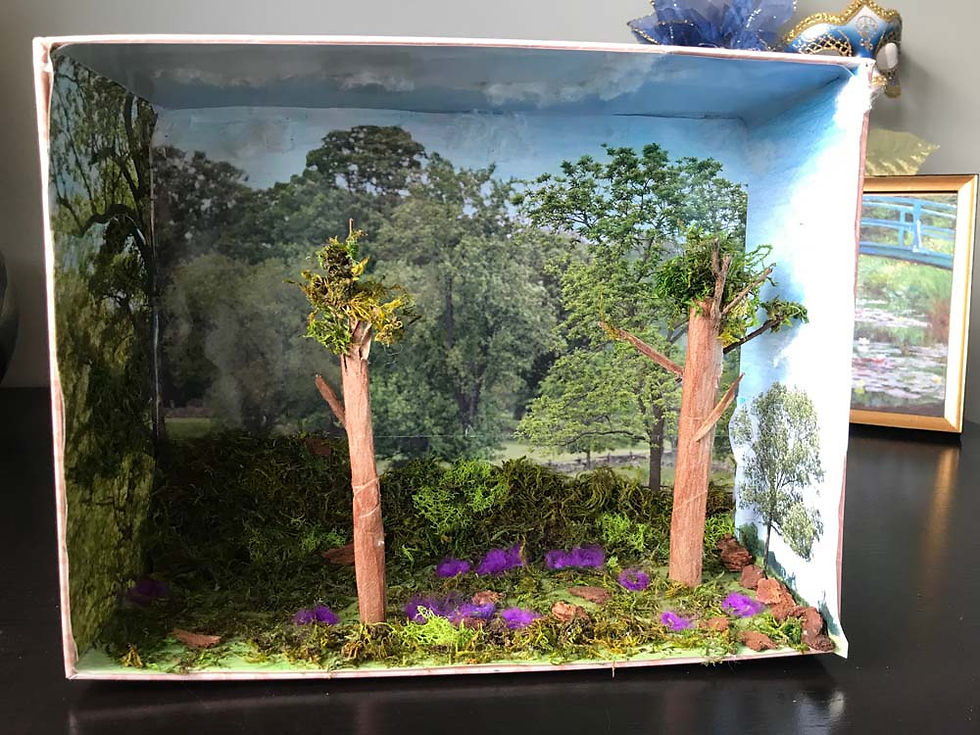
The teacher can find supplies to make these at Michael's, Hobby Lobby, and possibly some supplies from Walmart as well in the crafts isles. They will need:
Fake grass, trees, shrubs, vines, and other vegetation
Elmer's glue
Scissors
Fake lakes/water or materials to make this
Plastic animals and/or fake plants similar to the researched plants
Potentially more fake, mini materials for sea creatures, such as the lion fish (i.e. fake sea weed)
Small boxes, cut so one side is open, the top is open, and the sides are cut in triangles (long side towards back, short in the front).
If necessary, the teacher can make some of these materials rather than buy them, or host a fundraiser to afford some of the materials.
Students will research and put their box environment together for the rest of science time and half of science time the next day. They should reflect the environment these animals have taken over (wetlands for pythons for example) and will be displayed for the class to look at for the rest of the week, or however long the teacher wants.
Math
Students will begin woking on new standards today: comparing fractions and decimals to themselves and each other (MAFS.4.NF.1.2 and MAFS.4.NF.3.6 and 7).
Begin by introducing fractions. Many kids are likely to have forgotten this or never have learned it, so it will likely take the entirety of math time. You (the teacher) can implement the environmental unit plan in some ways regardless, such as utilizing the old okapi exhibit model from week one. You can take some tape and divide the exhibit up into halves and quarters. Ask the students to identify how many equal parts there are in the exhibit, have them point out how many fourths have a pond, or which half has the most trees. It would make an excellent visual for reviewing and/pr introducing fractions. The teacher can write on the board as he/she goes as well. For example: "Which half has the most trees?" As the teacher emphasizes the word "half" he/she can write "1/2" on the board.
Once the students seem to have a decent handle in remembering fractions, the teacher can move on to comparing fractions. For example, "1/2 of the okapi exhibit is equal to 2/4 of the exhibit. What has more space: 1/4 of the okapi exhibit or 1/2?" Once the answer is given, the teacher can show how to write the inequality. The teacher can continue utilizing tape, or another form of separation, to illustrate this. He/she can even draw out a rectangle on the whiteboard to represent the exhibit, doodle in a couple trees and a pond, and continue using it for the lesson without it becoming cumbersome to hold or place under the projector.
Move onto thirds and other fractions, and begin work on adding with common denominators.
Day 4
Science
The students should continue working on their project from last class for half of the science time and turn in their worksheets.
Discuss some of the top invasive species in the world: zebra muscles (invasive to North America, Europe, and Russia), European starlings (invasive to North America, Southern Africa, Australia and New Zealand), and water hyacinths (invasive to Africa, Asia, North America, Australia and New Zealand (Florida is hit by these too)). There are animal, plant, and shellfish examples in this list, all of which have been introduced to North America but also to other continents around the globe. More examples can be found here: https://www.earthrangers.com/top-10/ten-of-the-worlds-most-invasive-species/
If time, show this video on invasive species in the Everglades, or show it to start next class: https://www.pbs.org/video/war-on-invasives-crp0sn/
Create a worksheet with 8-12 questions for the students to answer as they go about, focusing on what the Swamp Apes do, how the animals were brought into Florida's ecosystem, and why they are wrecking havoc in the Everglades and other parts of Florida (impacts on people, plants, and animals). Be sure most are free response questions.
Math
Today the class will continue working on fractions. First, review what the students learned last class; you (the teacher) can use the okapi exhibit again. For example, "Who remembers what it's called when I split the habitat into two equal parts? What about four?" You can utilize the power point listed in the next paragraph for bell work as well.
Since the students have just watched the PBS video (or will be watching it tomorrow) on invasive species that covers lygodium, feral hogs, etc., the teacher can come up with multi step problems relating to this to introduce more about fractions and how they can be useful. For example, see the powerpoint on the Wordpress site titled "Envrn_Fractions.pptx". The teacher can make many more multi step problems to further introduce the students to fractions, today incorporating subtraction while still working on addition using word problems with the class and individual worksheets.
Day 5: Finish on Invasive Species
Science
If there wasn't enough time last class, show the video from PBS to start class and have the kids fill out the worksheet.
Otherwise, begin class with this video, explaining that people may bring species places by accident, but it's really hard to fix an invasive species problem. https://www.abc.net.au/btn/classroom/macquarie-island/10534316
Explain that while many instances of invasive species are bad, there are some times when invasive species can help the environment. For example, the introduction of Aldabra tortoises to replace the extinct native giant tortoises on the island of lle aux Aigrettes led to a bigger and better spread for the endangered ebony forest on the island.
To finish up on invasive species, the kids will play this simulator/game in the computer lab. https://florida.pbslearningmedia.org/resource/plum14.sci.life.invaders/invaders/
It follows native plants and animal species in the areas around the world, from Australia to the Canadian Rockies. It also does a good job of showing that just because an animal is invasive to one area doesn't mean its a "bad" animal. For example, the moose is portrayed as invasive in one area, while it's native to Canada. Although the invasive animals aren't all accurate to those areas, it's a good simulator regardless to show the idea.
If the teacher is unable to use the computer lab but has 3 or 4 classroom computers available, the teacher can have most students perform another task, such as silent reading, while the computers are used for 5 minutes at a time in rotations. Four students can play the simulator for five minutes, then go to silent reading while four new students play the simulator and so on.
Math
Students will learn what a basic inequality is to start the lesson and how to write inequalities i.e.:
"Which is greater: 5 or 8?" "To show that a number is greater than another number, we use inequalities, which look like this" *draw < and > on the board*
"If you draw some teeth on these symbols, they look a lot like open alligator mouths!" *draw teeth on the < and >*
From her, show kids how to write the inequality: either 5 > 8 or 8 > 5. "The alligator always wants a big meal, so he eats the greatest number!"
Be sure to explain that when values are equal, you just use a = sign between them.
Create some very basic inequality problems to do with the class as a group and take volunteers to help out along the way, ensuring class participation. Then, use centers to encourage the students to learn more about them individually, with a group, and collaboratively.
Center 1: Individual worksheets on basic inequalities. You can make this like "rocket math" where the three who kids answers the most questions correctly during the span of the center get a prize (after you grade them of course).
Center 2: Collaborative Group Work. Set up a series of word problems. This can be one section of data per question, several questions to a section of data, or a mix of both. You can use charts as well relating to the unit plan, such as "Number of pythons per square mile by year in Everglades," where you have a two column chart with "Estimated number of pythons per mile" and "Year." Several questions could ask students to compare different years. You can also have large data sets going towards several questions in a similar manner.
Center 3: The teacher leads a group of kids on the carpet with whiteboards to help them learn inequalities. Set up basic problems, word problems, etc., and have the students write on their whiteboards and hold them up to encourage participation. Encourage students to ask questions, and the teacher should ask students how they got right and wrong answers to help students understand good ways of thinking for inequalities.
Switch centers every 7 minutes until everyone has had their full 7 minutes at each center.
If the teacher has the opportunity to go to the computer lab, that would be preferable for this exercise. If not, it can be implemented into centers (Center 4) using the classroom computers. Have the students load up this game on their computers to get them used to simplifying fractions and finding fractions that are equivalent. https://mafs.mathgames.com/play/math-slither.html
Instructions for Students:
1. Load the game
2. Push play
3. Select grade 4
4. Select fractions
5. Use your mouse to move around (no clicking needed). Eat the dots to get bigger, eat the correct fractions to get bigger, and eat smaller worms/snakes from the back to get bigger. Don't let other snakes eat you from the back, don't run into other snakes head on, and don't the wrong fraction, or you will get smaller or die. Try to be the biggest snake possible!
Hopefully, students can spend 20 minutes on this game, but if in centers, those 7 minutes are fine.
Social Studies
Today the students will research important people in Florida's history (SS.4. A.6.3), and in compliance with this unit, they will research people who are important to the history of Florida's nature. For example, Marjorie Stoneman Douglas was one of the leaders of ensuring the protection of the Everglades. Marjorie Kinnan Rawlings was a Florida author, weaving her experiences in the Florida wilderness into her stories. Her home and property were later turned into a state park after she died and is preserved as if she still lived there today. The teacher should choose three or four people who played an important role in Florida's ecological history (one or two of them can even be a "bad guy", such as Napoleon B. Broward, who drained a lot of the Everglades before people realized its importance). Students should use print material (maybe articles the teacher has printed or small books on the people chosen) as well as digital resources if possible (SS.4.A.1.2). Perhaps one student from each group can use a classroom computer while the others use text, and then the students can reconvene and share what they found.
The assignment should encompass:
- A drawing of the person the students are researching.
- Was this person a positive or negative impact on Florida's wildlife?
- What did this person contribute to Florida's wildlife (good and/or bad)?
- Was there anything else important this person contributed to Florida other than things nature-related? (For example, Broward contributed a lot to Florida's higher education).
- If you could meet this person, what is one thing you would ask them or say to them (one question or comment per student)?
This should take no more than 40 minutes for the students to complete. Students should share their picture with the class using the projector and speak only about what this person contributed to Florida's environment. Presentations should take no longer than 3 minutes each. They will turn in all of their learned information, written down, to the teacher.
Comments